
Equipment familiarisation
Locate controls, follow setup checks and recognise alerts. Staff can prepare before access to a training device or clinical room is available.
Rehearse equipment use, procedure sequences and team decisions in a supervised training programme. Repeated practice gives educators more opportunities to identify gaps before a practical assessment.
Discuss your project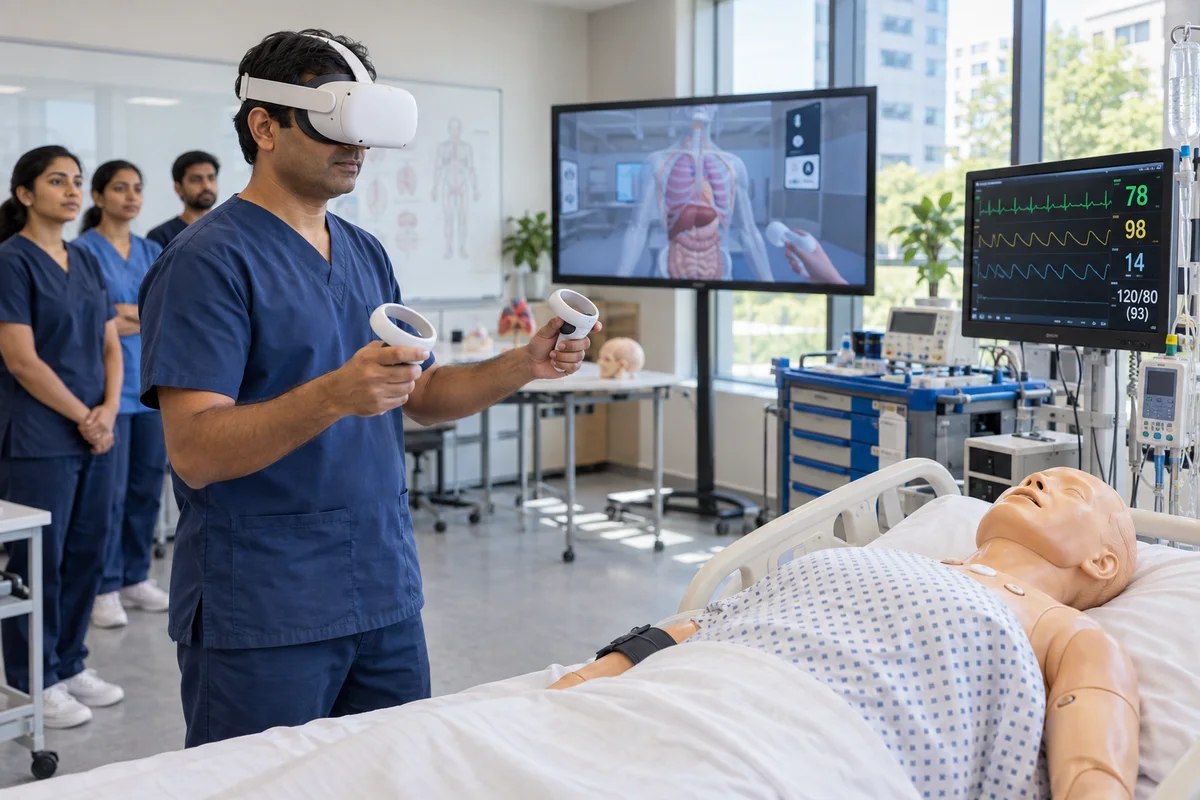
PRACTICAL USES
Educators need repeatable practice opportunities without relying on patient exposure for every repetition.
Locate controls, follow setup checks and recognise alerts. Staff can prepare before access to a training device or clinical room is available.
Practise an approved sequence and review missed steps with an educator. The module supports preparation; clinical skill still needs supervised assessment.
Work through a handover or escalation scenario. Debriefs can examine what was reported, who acted and where communication broke down.
PUBLISHED INDUSTRY EVIDENCE
A 2002 randomised study of 16 surgical residents compared proficiency-based VR simulator training with no VR training. The result concerns a specific laparoscopic task and an older surgical simulator; it is not a general claim about patient outcomes.
Source: Seymour et al., Annals of Surgery (2002)External research and implementation examples. These are not measured results from Vrelab projects.
MEASURE YOUR PILOT
WHAT WE NEED FROM YOU
A clinical educator, approved protocols and a clear assessment rubric. Use dummy patient information and review the scenario whenever the clinical protocol changes.
COMMON QUESTIONS
No. Use it as preparation and additional practice. Educators must assess clinical competence using the appropriate practical and professional standards.
A bounded task such as equipment setup or a handover works well for a pilot. Define the correct actions and measure performance with the same checklist before and after training.